Programming technique · B2.2.4
Queues
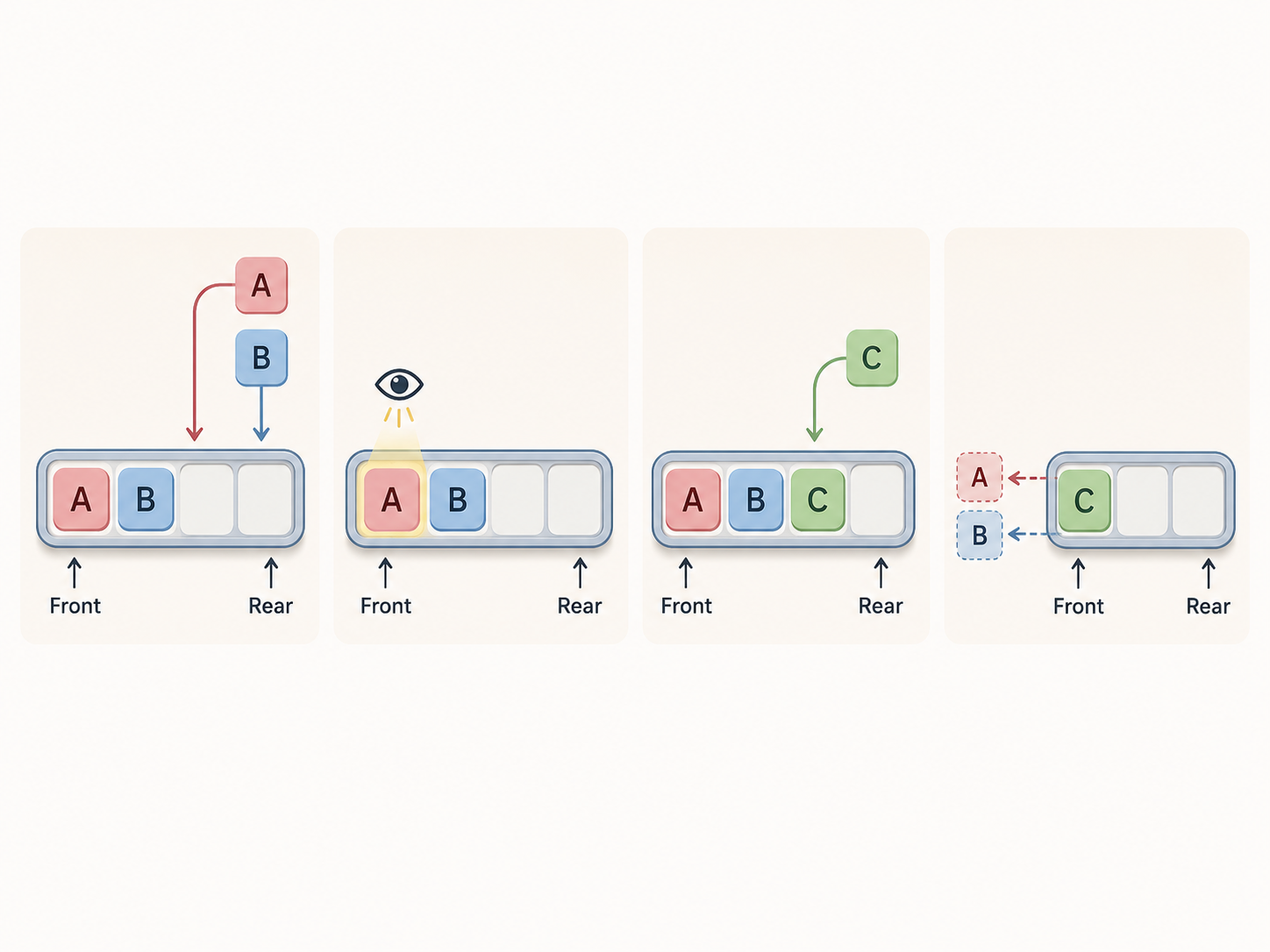
A queue adds new items at the rear and handles existing items from the front. This preserves arrival order: the first item added is the first item available for removal.
The four required operations
enqueue
Add one item at the rear.
dequeue
Remove and return the front item.
front
Return the front item without removing it.
isEmpty
Check whether a front item exists.
Using Java's supplied queue operations
Java can represent a queue with the Queue interface backed by ArrayDeque. Here, offer, poll and peek correspond to enqueue, dequeue and front.
Using collections.deque as a queue
Python's collections.deque supports efficient operations at both ends. Use append() at the rear, popleft() at the front, and queue[0] to inspect the front.
| Abstract operation | Java call | Returned value | Queue after operation, front first | Stored count |
|---|---|---|---|---|
| enqueue Poster | offer() | true | Poster | 1 |
| enqueue Map | offer() | true | Poster, Map | 2 |
| front | peek() | Poster | Poster, Map | 2 |
| dequeue | poll() | Poster | Map | 1 |
| isEmpty | isEmpty() | false | Map | 1 |
| Abstract operation | Python call | Returned value | Queue after operation, front first | Stored count |
|---|---|---|---|---|
| enqueue Poster | append() | — | Poster | 1 |
| enqueue Map | append() | — | Poster, Map | 2 |
| front | queue[0] | Poster | Poster, Map | 2 |
| dequeue | popleft() | Poster | Map | 1 |
| isEmpty | len(queue) == 0 | False | Map | 1 |
Performance and memory, explained qualitatively
Use the two queue ends
Normal queue processing adds at the rear and removes at the front. Arbitrary middle removal is not the queue abstraction.
Stored memory changes
enqueue stores one more item and dequeue stores one fewer. front and isEmpty do not change the count.
Check before removal
An empty queue has no front item. Check first rather than removing or indexing a value that does not exist.
Challenges Choose one
Choose a challenge that feels appropriate for you. Code heat is only a rough estimate, not a fixed level.
Queue Operation Trace
SelectedCollect the queue tracing sheet from the front of the class. Before running the supplied Java program, trace every operation by hand. Record the returned value, queue state from front to rear and stored-item count after each step. Hand the completed tracing sheet to your teacher, then run the program and correct any mistakes in a different colour. Explain why front leaves the queue unchanged. Do not implement a custom queue.
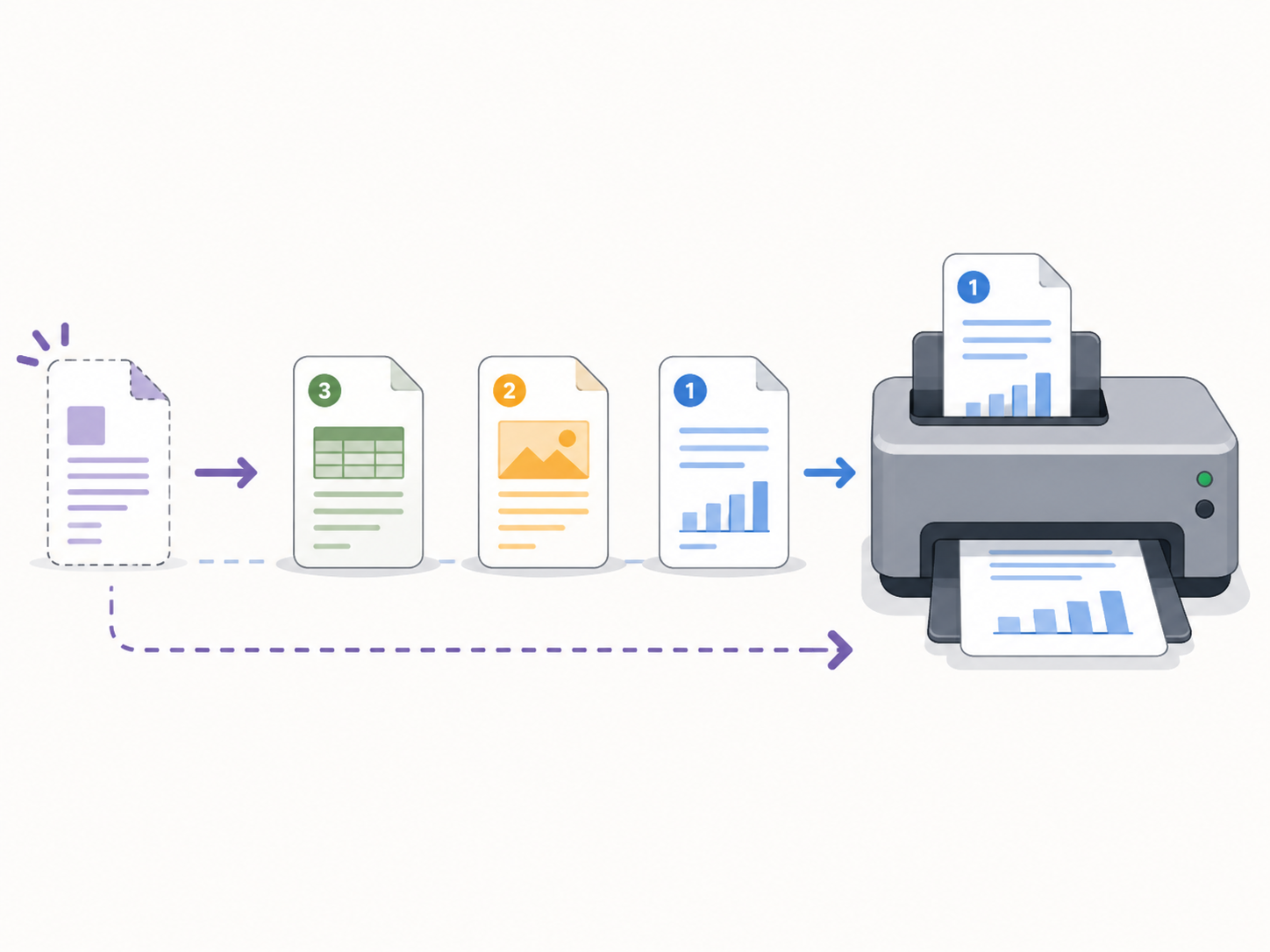
Print Queue
SelectedUse a Queue<String> for print-job names. Provide options to add a job at the rear, view the next job, print and remove the front job, and report when no jobs remain. Keep queue operations in clear methods and explain why first in, first out preserves ordinary arrival order. Do not add priority processing.
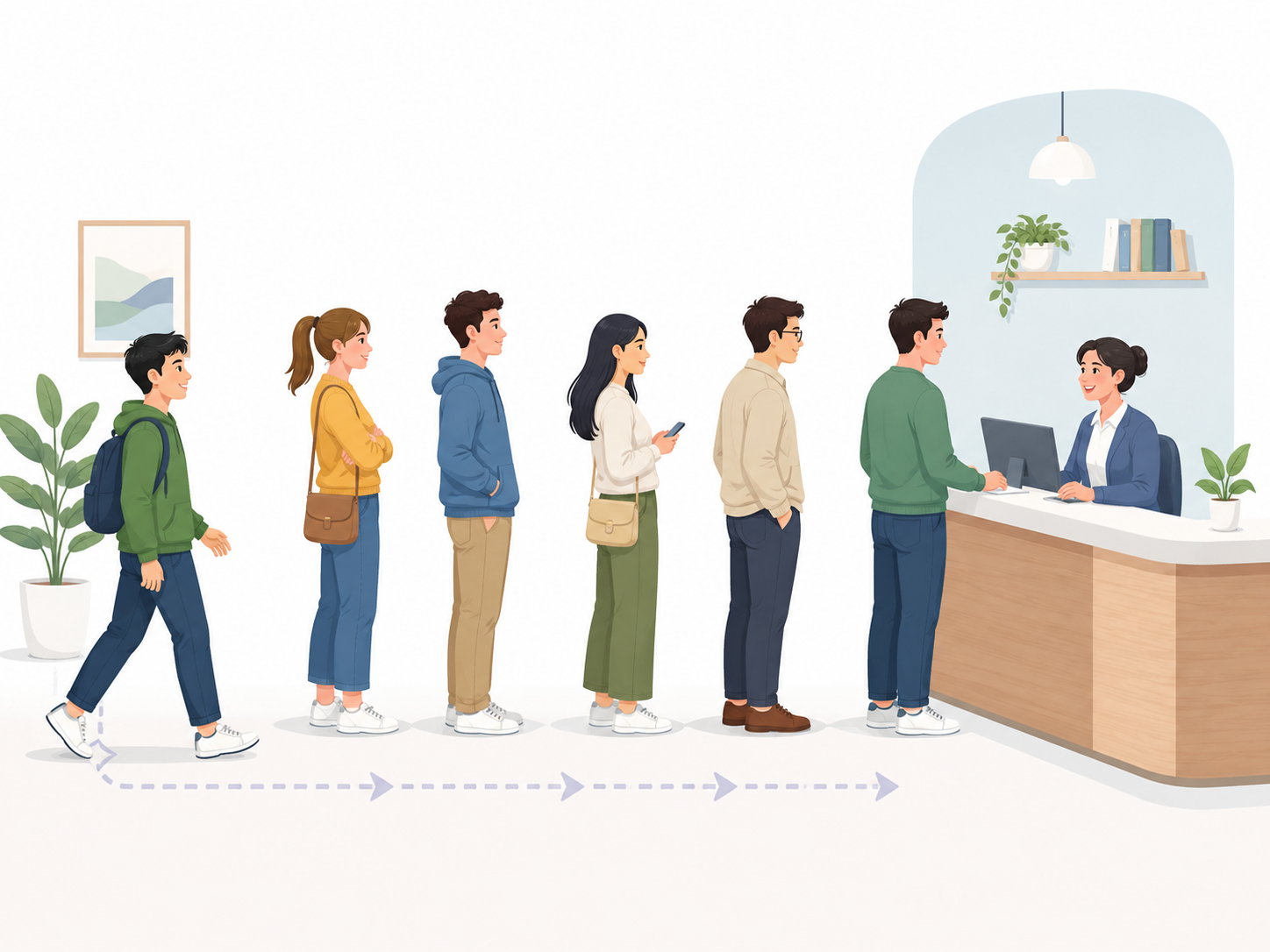
Customer Service Queue
SelectedUse a queue to store customer names in arrival order. Allow customers to join, show who is next and serve the front customer. Track how many customers have been served and prevent removal from an empty queue. Include a short explanation of why a normal first in, first out queue is fair for this scenario.
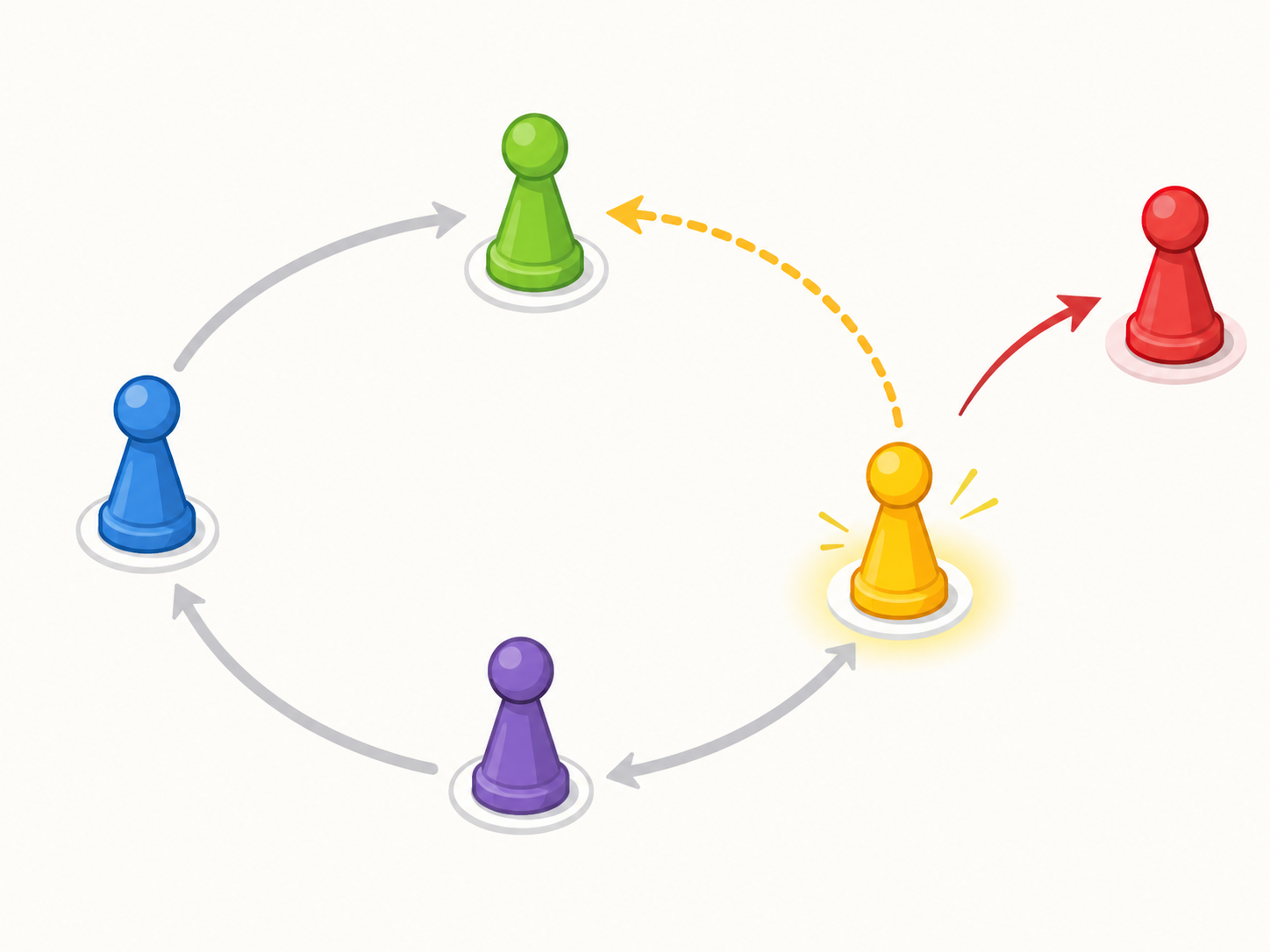
Round-Robin Turn Queue
SelectedUse a queue of player names to manage repeated turns. Remove the player at the front, run one turn, then add that player to the rear when they remain active. Remove eliminated players permanently. Demonstrate several complete rotations and explain how dequeue followed by enqueue preserves the turn order.
Selected challenge
This choice is shared with the portfolio setup page.
Create your challenge folder
Run this command before starting. It creates the correct empty folder inside your portfolio.
Complete the challenge
Write and test your own solution in the folder created above.
Optional scaffolded support
Use only as much support as you need. The templates organise the program but leave the important algorithm unfinished.
Submit for review
Run this when your program is complete. It creates the README, commits the folder and pushes it.